How to Reduce Risk When a Curtain Cannot Be Removed
No checklist can make an installed curtain hurricane-proof. The goal is to reduce avoidable load and prevent predictable damage without creating new hazards.
Furl or Reef the Skirt Only with a Suitable System
Raising the skirt reduces the area exposed to current and can help prevent ballast from snagging as water levels change. Use purpose-built reefing lines where available and keep the furled material compact, evenly supported and clear of propellers.
Do not improvise a few tight ties that create point loads, cut the fabric or allow the chain to swing freely.
Protect Anchors and Load Distribution
Inspect every curtain attachment, bridle and line. Correct chafe points and confirm hardware closure. Where a qualified designer calls for added or repositioned anchors, the complete arrangement must account for bottom conditions, changing water level, directional loading and safe retrieval. Adding a heavy anchor to an inadequate attachment point can simply move the failure to the curtain, cable or connector.
Reduce Contact and Debris Exposure
Move stored lumber, pipe, pallets, loose dock materials and construction waste away from the water before the storm. NOAA recommends moving loose items indoors or tightly securing items that cannot be moved to reduce storm-generated marine debris. At the curtain, use approved separators or stand-offs where ordinary contact with pilings is expected, but do not assume they can absorb vessel or large-debris impact.
Maintain Visibility and Navigation Coordination
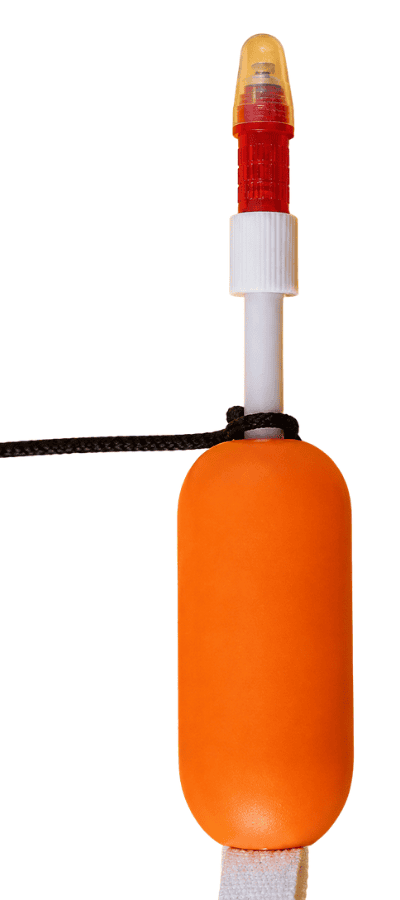
Marker buoys and lights can help identify the barrier before and after the storm, subject to local requirements and the risk that they themselves become debris. Coordinate with the project owner, harbormaster, Coast Guard or other authority when a displaced curtain could obstruct navigation. Record the installed location and section count before evacuation so missing equipment can be identified later.
Prevent Overtopping and Submergence
Overtopping is not solved by tightening anchor lines until the boom is rigid. Excessive downward line load can pull flotation under as water rises or waves pass. Verify freeboard, float condition and anchor-line geometry. Any adjustment must preserve the curtain’s ability to follow the water surface within the intended range.
Do not create a false sense of security!
Extra anchors, heavier chain, larger floats, dual cables or a Type 3 label may be appropriate components of a demanding installation. None should be marketed or treated as a stand-alone hurricane guarantee.
Protected Inland Ponds & Small Lakes
Read MoreStorm Concerns
Wind setup, rapid runoff, floating branches, shoreline anchor erosion.
Planning Emphasis
Early removal is often practical. Verify that “protected” remains true under forecast wind direction and inflow.
Large Lakes
Read MoreStorm Concerns
Long fetch can generate damaging waves even without a tide.
Planning Emphasis
Treat exposed shorelines more like coastal sites; consider retrieval time and distant debris.
Rivers
Read MoreStorm Concerns
Rising stage, faster current, whole trees, reversing eddies and inaccessible banks.
Planning Emphasis
Current can increase after local rain has ended. Remove early or use a site-specific plan; do not work from flooded banks.
Canals and Drainage Waterways
Read MoreStorm Concerns
Rapid water-level change, concentrated flow and debris from upstream neighborhoods.
Planning Emphasis
Check that the curtain will not become a blockage or redirect flooding; coordinate with the responsible authority.
Bays and Estuaries
Read MoreStorm Concerns
Storm surge, tide, wind waves, reversing current and vessel movement.
Planning Emphasis
Evaluate both load directions, water-level range and navigation. Removal is strongly favored when safely feasible.
Harbors and Marinas
Read MoreStorm Concerns
Some wave shelter, but high risk from boats, docks, pilings and loose equipment.
Planning Emphasis
Debris and crushing may control risk more than current. Secure surrounding property and coordinate harbor operations.
Open Coastal Environments
Read MoreStorm Concerns
Surge, breaking waves, large debris and limited safe access.
Planning Emphasis
A standard deployed curtain should not be assumed to survive. Plan removal well before onset of hazardous marine conditions.
High-Current or High-Wave Sites
Read MoreStorm Concerns
Large hydrodynamic load, limited inspection access and rapid escalation.
Planning Emphasis
Require project-specific engineering and conservative stop-work/removal triggers.

How to Inspect a Turbidity Curtain That is Already Installed
A turbidity curtain can look fine from a distance while hidden damage to anchors, connectors, flotation, fabric, seams, ballast, or tension cables is already reducing its performance. Routine turbidity curtain inspections while the system is installed can help crews identify problems early, document defects accurately, and determine whether a section should be repaired, replaced, or repositioned before a minor issue becomes a costly failure. Let's walk through the key components to inspect, along with practical tips for documenting damage and performing inspections safely from shore or by boat. Anchor Systems ASTM Universal Connectors Flotation Fabric Chain Ballast Tension Cables Inspect [...]

State of NJ DOT Compliance
1) What laws and permits actually apply? Federal backbone (Clean Water Act) NPDES construction stormwater / dewatering: Federal Construction General Permit (EPA 2022 CGP) introduced turbidity benchmark monitoring for certain dewatering discharges (weekly-average benchmark; exceedances drive corrective action). Even where states run their own programs, the CGP shows federal expectations for handling sediment/turbidity in pumped water. US EPA+1 USACE permits (Sections 404 & 10): In-water work, dredging, or fill typically needs a USACE permit. These permits often set project-specific turbidity and resuspension controls (e.g., floating turbidity barriers installed to near-bottom and maintained through construction). U.S. Department of Defense 401 Water [...]

State of New York DOT Compliance
1) What laws and permits actually apply? Federal backbone (Clean Water Act) NPDES construction stormwater / dewatering: Federal Construction General Permit (EPA 2022 CGP) introduced turbidity benchmark monitoring for certain dewatering discharges (weekly-average benchmark; exceedances drive corrective action). Even where states run their own programs, the CGP shows federal expectations for handling sediment/turbidity in pumped water. US EPA+1 USACE permits (Sections 404 & 10): In-water work, dredging, or fill typically needs a USACE permit. These permits often set project-specific turbidity and resuspension controls (e.g., floating turbidity barriers installed to near-bottom and maintained through construction). U.S. Department of Defense 401 Water [...]